Markets & Applications

Author: Ellis Fowler

Tecbond polyamide adhesives: Everything you need to know

Polyamide adhesives are a unique subset of hot melt adhesives, providing distinct properties that set them apart from other forms of hot melt. Unlike conventional EVA or metallocene-based hot melts, polyamides offer a combination of tensile strength, high-temperature resistance, and strong adhesion to a wide range of substrates. They are used in a wider variety of applications, from automotive to textiles, thanks to their versatility and efficiency.

What is a polyamide adhesive?

Polyamide, in its most basic sense, refers to a chain of polymers linked by amide bonds. Although polyamides exist in nature (e.g., silk), those used as adhesives are synthetically produced. Possessing strong adhesive properties, polyamide-based hot melts exhibit high performance with increased resistance to both high temperatures and harmful chemicals.

Benefits of polyamide adhesives

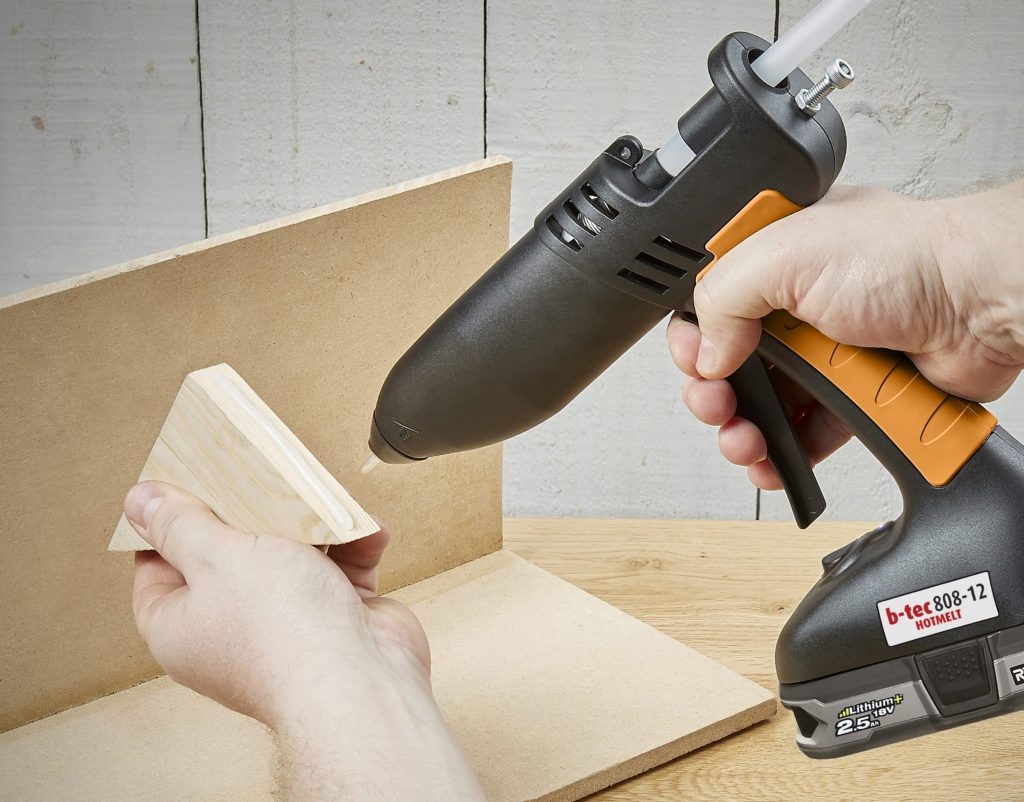
Unlike other adhesives that rely on the processes of drying and curing, hot melts form bonds through heating and cooling. The adhesive is melted in a glue gun, and this molten adhesive is applied to a substrate. Another substrate is then introduced and secured in place by the hot melts molten tack. The adhesive then cools, forming a bond.

While hot melts promote faster working times, without any harmful chemicals, they can unfortunately struggle to retain their performance in very warm temperatures.

Polyamides, however, have much higher heat resistance and softening points than EVA and polyolefin-based hot melts. The tecbond range of polyamide adhesives can withstand temperatures of over 110°C without compromising bond strength. Despite this increased resistance, they are no more difficult to work with than any other tecbond grade.

Polyamide adhesives also offer superior chemical resistance compared to EVA or polyolefin-based hot melts. This enhanced chemical resistance is primarily attributed to the chemical structure of polyamides. Tecbond polyamides have been used in the automotive industry for many years thanks to their superior chemical resistance. Not only are they used to secure components in fuel and oil filters, but they’re also used as an encapsulation adhesive to protect fragile electrical components.

Lastly, polyamides have almost unmatched tensile strength among hot melts. Tensile strength refers to how much a substrate can be stretched and manipulated without breaking. As an example, elastic bands have high tensile strength because they can be stretched a great distance before they snap. Conversely, concrete, despite its high compressional strength, has very low tensile strength and will break very easily if exposed to the right force.

An adhesive with high tensile strength requires a much greater force to pull apart and tends to be less brittle than adhesives with low tensile strength.

The range of tecbond polyamides

Tecbond polyamides are widely used across a number of markets, including product assembly, woodworking, automotive, and electrical. A full list of the tecbond polyamide grades can be found in our adhesives guide.

When kept dry and sealed in their foil-coated, resealable packaging, tecbond polyamides will last up to two years, almost double the shelf life of comparable polyamide adhesives.

As with all grades in the tecbond adhesive range, tecbond polyamides work best with the wide selection of tec applicators. These adhesives and applicators are designed and manufactured to provide optimal performance when used together.

For more information regarding our polyamide grades and compatible applicators, please don’t hesitate to contact our sales team.

sales@poweradhesives.com

+44 (0)1268885801
Open time: What is it and what affects it?

You may have heard the phrase “open time” when reading about adhesives but not know what it means or what it represents. Open time is an important factor to consider when choosing the correct adhesive for the job. Below, we will go into what open time is and why your use cases and working conditions can affect it.

What is open time?

Open time is defined as the length of time after application in which an adhesive can still be manipulated. In a more basic sense, open time is the amount of time you have between applying the adhesive, and it solidifying to the point where it won’t bond to another substrate.

When looking at the open time of an adhesive, it is important to look at how long it typically takes to complete the entire process of bonding materials, also known as the process open time. For example, if you are using an adhesive for carton closing, the process open time would include dispensing adhesive onto the carton, putting the applicator down, and then closing the carton to form the bond. It is therefore important to choose an adhesive with an open time longer than the process open time.

Hot melts differ from other forms of adhesive in that their open time is based on how long it takes the adhesive to cool and turn back into a solid. Other adhesives open times are based on curing or drying speeds.

An adhesive’s open time will usually be displayed somewhere on the packaging or in the product’s technical data sheet. It is, however, worth noting that there is no set method within the adhesives industry for testing open time. This means that most manufacturers will have their own set of tests to determine open time.

What affects open time?

Understanding what factors influence an adhesive’s open time is crucial for ensuring optimal bonding performance.

When manufacturers conduct their open time tests, they will always try to ensure the conditions of the test remain constant throughout. However, as mentioned previously, with no set testing method for adhesive manufacturers, each company has their own conditions, which means another company may end up with a completely different result.

With hot melts specifically, everything is based on the temperature and cooling speed of the hot melt. For this reason, the most common factors that affect their open time are ambient temperature, substrate material, application temperature and application volume.

Ambient temperature will greatly affect the speed at which hot melts begin to cool and solidify. In warmer conditions, hot melts will stay molten for longer, resulting in an extended open time. Conversely, in colder environments, the hot melt will cool quicker, decreasing its open time.

This is much the same with the substrates being bonded. The colder the surface temperature of the substrate, the quicker the adhesive will solidify. Substrates such as metal are also very thermo-conductive meaning they will draw the heat energy from the adhesive much faster than fabrics for example.

An open time factor unique to hot melts is the application temperature. Much the same as the temperature conditions of the room or substrate, the lower the application temperature, the faster the adhesive will reach its solidification temperature, decreasing open time. The low melt formulations in the tecbond range such as LM41, LM42 and LM46 are designed to have similar open times as many of the regular tecbond grades but at lower temperatures. For example, LM46 has a similar open time to tecbond 240 but is designed to be applied at 130°C as opposed to 195°C.

Lastly, there is the amount of adhesive applied. Larger volumes of adhesive in a single area will retain heat and take longer to cool. This is why in carton closing applications, we advise users to apply a smaller bead to the carton before closing. This gives users enough adhesive to provide a strong bond without long waiting times for adhesives to set.

In conclusion, adhesive open time plays a crucial role in many industries, from construction to manufacturing. By considering the above factors and conducting proper testing, professionals can select the most appropriate adhesive and application technique to achieve desired results.

For more information about the tecbond adhesive range, please speak to our dedicated sales team who can guide you to the right adhesives and applicators for your task.

sales@poweradhesives.com

+44 (0)1268 885801

Tecbond 7785 – The temperature and chemical-resistant hot melt for the automotive industry

A leading polyamide adhesive in the tecbond range, tecbond 7785 is the go-to grade for bonding substrates that regularly experience high temperatures and frequent chemical contact. Much like many other polyamide grades in the tecbond range, its benefits and usability stretch far beyond that of chemical resistance.

Tecbond 7785 is a polyamide adhesive designed for product assembly and some specialist packaging applications. The adhesive works best on wood and fabric but has also proven excellent for bonding most metals and many composite plastics. 7785 can also be used as an encapsulation compound for protecting fragile electronics.

Capable of being subjected to temperatures as high as 135°C and as low as -10°C, tecbond 7785 is one of the most versatile adhesives in the tecbond range. This heat resilience, coupled with its class-leading chemical resistance and encapsulation properties, is what makes 7785 ideal for the assembly of parts in the automotive industry. Many large car manufacturers use tecbond 7785 to not only construct their oil and air filters but also protect the car’s smaller electronic components.

Featuring a very high molten tack, bonding is almost instantaneous upon compression, with no additional clamping required to form a secure bond. Once properly set, the bond has enough flexibility to allow material movement without causing cohesive or substrate failure.

Tecbond 7785 is part of the automotive range of tecbond adhesives, along with grades including 267W and 246, which can be used in the production and maintenance of vehicles. This is perhaps one of the most demanding areas for hot melt adhesives, as difficult substrates, combined with temperature and chemical resistance requirements, make adhesive selection challenging.

Tecbond 267W is a white, polymer-based hot melt adhesive designed to bond polyolefin plastics through a chemical bond. This ability to bond plastics makes it unique among hot melt adhesives. Tecbond 267W is widely used in the production of crash helmets, sun visors, automotive trim, and white goods.

Tecbond 246 is a specialised hot melt designed for use with PDR (paintless dent removal) systems. The adhesive is added to a dent-pulling tab and bonded to the dent. After 5–10 minutes, the mechanism is ready to pull the dent out and restore the panel to its original shape. The bond is then loosened by pulling the attachment sideways. Once removed, the excess residue is cleaned using white spirit, acetone, or thinners.

All tecbond automotive grades are designed to be used with the tec range of applicators to achieve the highest possible output whilst minimising effort. Tec glue guns are designed to heat up within three minutes and dispense upwards of 1kg an hour, reducing downtime and allowing users to work faster.

Tecbond 248 – The strong and reliable multi-purpose hot melt adhesive

One of the best-selling formulations in the tecbond range, tecbond 248 takes hot melt glue sticks to a new level in performance bonding. Used in both the construction and product assembly industries, its strong bonding properties, coupled with a good open time and fast setting speed, make it the go-to adhesive for tradespeople.

Tecbond 248 is an acrylic-based, clear hot melt adhesive designed to provide exceptional adhesion to a wide range of substrates, including many plastics that otherwise have proved difficult to bond. Excellent bonds can be achieved on wood, fabric, leather, concrete, rubber, glass, ceramics, and most metals. 248 has also been widely used on many plastics, such as PVC, polycarbonate, and acrylic thanks to its strong chemical bonding capabilities.

When working with heat-sensitive substrates, tecbond 248 can be extruded at lower temperatures to reduce the risk of material damage. Reducing application temperature has the added benefit of increasing 248’s viscosity, negating any sag that can occur when applying to vertical surfaces. For the strongest possible bond, it is recommended to apply tecbond 248 at the highest possible temperature (around 195°C).

The grade is the go-to for many hardwood flooring and carpet installers due to its instant grab and good open time. Once applied, 248 will maintain its high tack for around a minute, allowing flooring or tack strips to be accurately positioned before compression. Once compressed, tecbond 248 sets almost instantly without the need for clamping or holding in place, facilitating faster working.

Complementing its bonding capabilities, 248 has excellent low-temperature resistance, meaning the bond will not become brittle if exposed to temperatures as low as -5°C.

When used with the tec range of applicators, tecbond 248’s delivery rate speeds up the application, while its low stringing content means that no adhesive is wasted when users release the trigger. The tec range of applicators is designed to work in partnership with the tecbond adhesive range to deliver optimal results with low effort and energy consumption. Any adhesive left in the applicator after use is not wasted but simply remelted the next time the tool is switched on. Tecbond 248 is available in 12mm and 15mm sticks and 43mm slugs.

As with a majority of adhesives in the tecbond range, tecbond 248 has a near-unlimited shelf life with no risk of expiring or drying out.

How does the spraytec system work compared to regular spray adhesives?

The spraytec system from Power Adhesives is a pioneering, innovative, and sustainable technology to replace solvent-based aerosol adhesives. Contrary to its name, the unique application method does not atomise the adhesive but instead creates a swirl pattern, ensuring a wide area of coverage with none of the drawbacks of traditional aerosol adhesives.

Despite their easy-to-use functionality, aerosol spray adhesives have a hugely negative health and environmental impact due to the VOC content, prompting users of these adhesives to look for cleaner, more cost-effective solutions.

So how does it work?

Unlike aerosol adhesives in spray cans, the spraytec system uses compressed air to dispense hot melt. The technology works by partnering a pneumatic, air-assisted applicator with uniquely formulated 43mm hot melt glue slugs. This size of glue ensures sufficient output without the need for a bulk melting tank.

When an adhesive slug is placed into the chamber, pulling the trigger sends compressed air through the tool, which in turn moves the feed mechanism. This mechanism pushes the glue slug into the thermostatically controlled heating chamber. The chamber maintains a constant temperature of 180°C to ensure adhesive is melted on-demand.

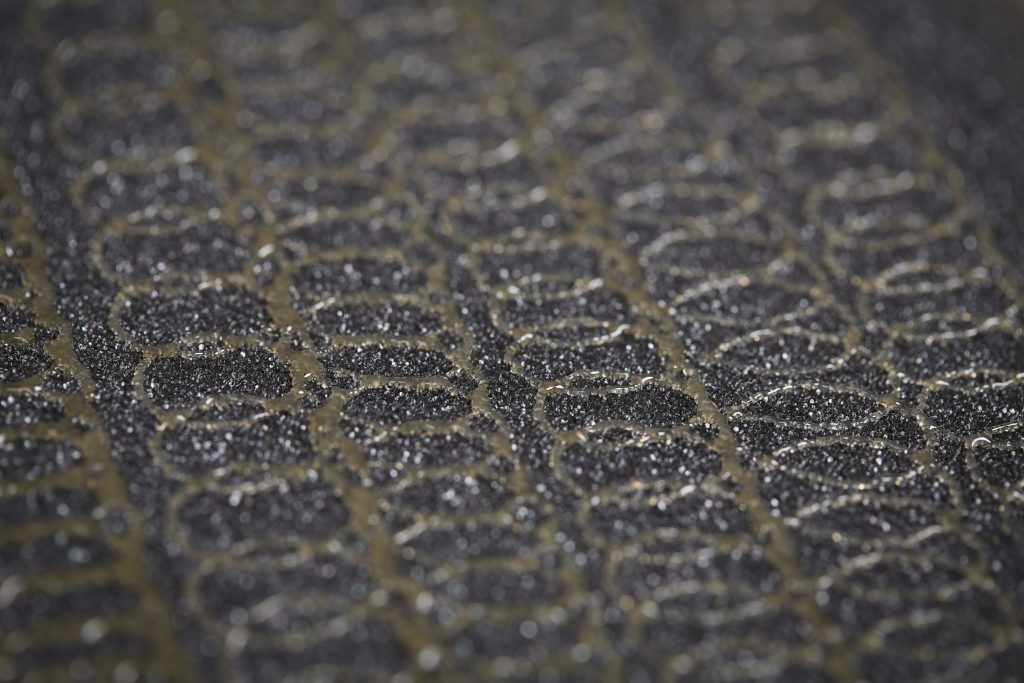
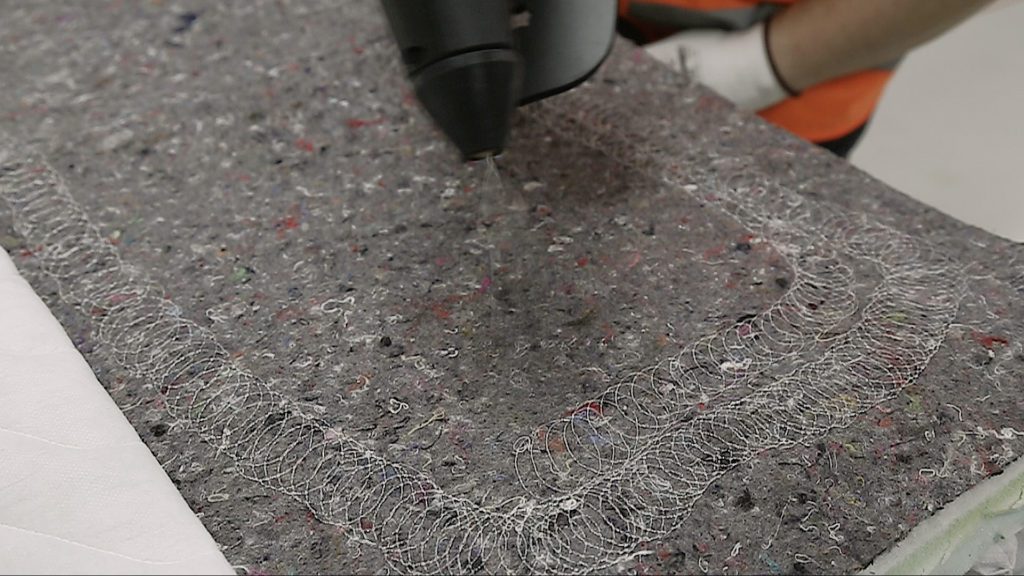
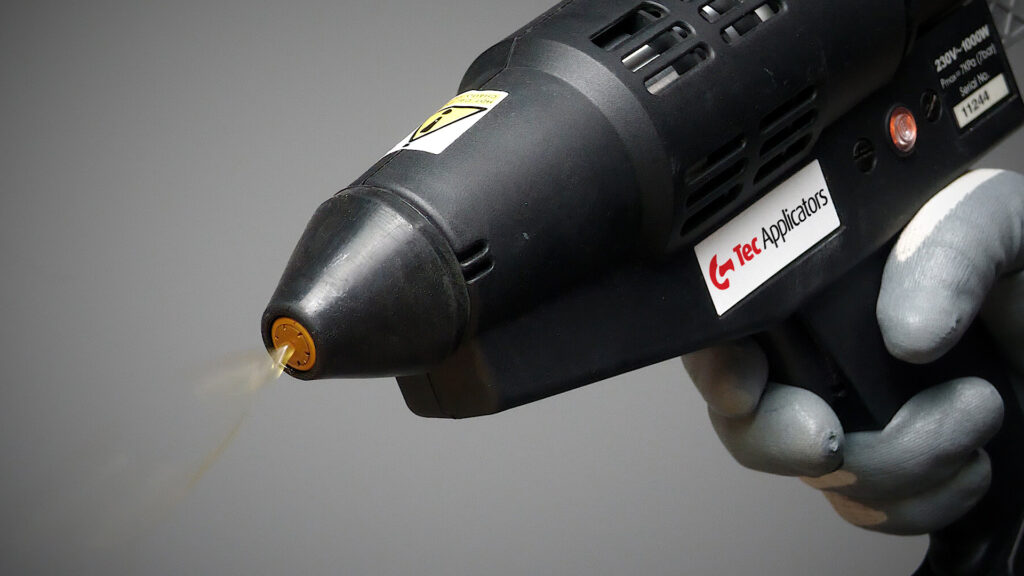
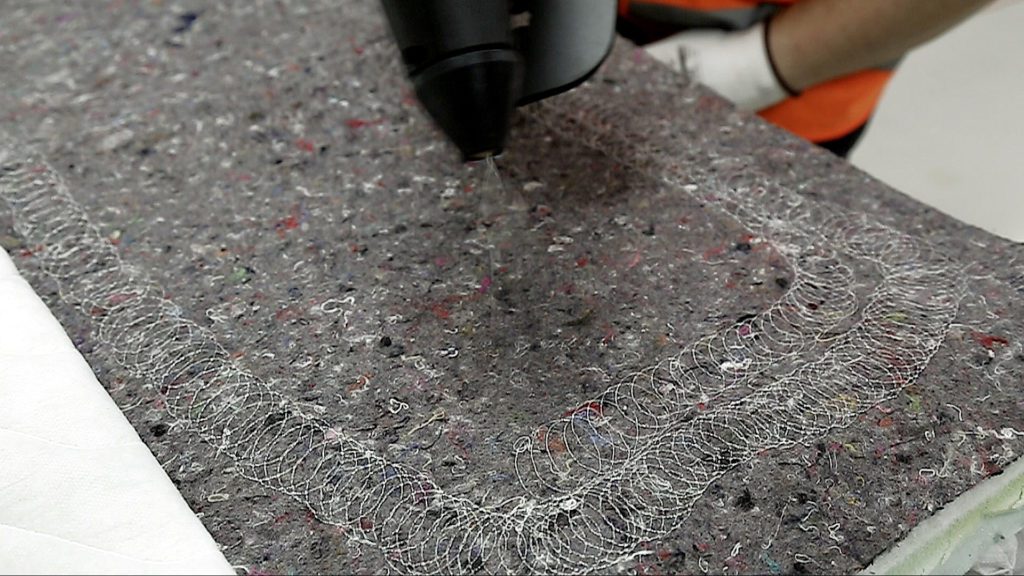
The now-molten adhesive is then pushed through the specially designed nozzle. As the adhesive is extruded through the central hole, compressed air is released through five small flutes on the outer ring of the nozzle. This causes a vortex around the bead of adhesive, forcing it into a spiral pattern. This pattern is adjustable using a small screw on the back of the applicator, which adjusts the pressure of the vortex air.

What are the benefits of the spraytec system?

The spraytec system removes the issue of VOCs commonly associated with aerosol spray adhesives and the waste product in empty cans or pots. Spraytec adhesives do not contain organic solvents or VOCs, which is not only cleaner for the environment, but also means operators can use the product without needing to wear PPE. This creates savings, and spraytec offers further value as 100% of the adhesive is used in the bonding process. This is compared to solvent-based adhesives, which contain only 30 to 40% solid contents, with the rest being VOC.

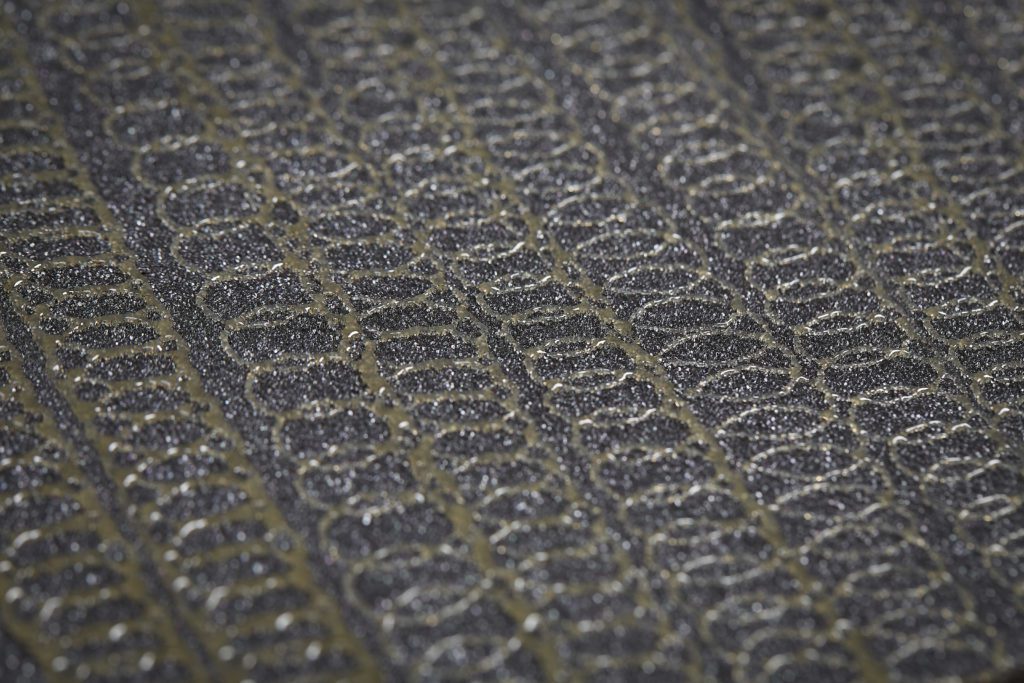
Compared to bead application, swirling hot melt allows users to cover a large surface area faster and affects the application temperature. As the adhesive is spiralised, it cools far quicker than a bead, allowing application to heat-sensitive substrates, like expanded polystyrene and foam, without causing damage. Another unique property of spraytec adhesives is their ability to stay tacky, even after they have cooled and gone solid. Spraytec grades 420, 425 and 430 all have open times of around three minutes or more, despite cooling and hardening within a fraction of this time.

All spraytec adhesives also have an unlimited shelf life. Without risk of expiry, any adhesive left in the applicator after use can simply be remelted the next time it is switched on and used as normal with no effect on the adhesive properties.

Spraytec adhesives have been used for over 15 years in the production of mattresses, POS stands, furniture, HVAC units and much more. The system continues to be at the forefront of what is achievable with hot melt adhesives.

For more information about the spraytec system, or if you would like to request a demonstration with one of our sales team, please don’t hesitate to contact us.

sales@poweradhesives.com

tel: +44 (0)1268 885801

Spraytec 410 & 420 – The “sprayable” hot melt adhesives

For over 10 years, Power Adhesives has been manufacturing specialised 43mm adhesive slugs designed to be applied via a unique spray-like application. The pioneering grades of this range, spraytec 410 and spraytec 420, not only provide users with a safer alternative to aerosol-spray adhesives thanks to their lack of harmful VOCs, but also allow them to use hot melt adhesive in situations where it would previously have been impossible.

Spraytec 410 and 420 are synthetic polymer-based hot melt adhesives formulated in tandem with the tec spray guns, to let users apply adhesive quickly and efficiently over large surface areas. Both formulations provide solid bonds to a variety of substrates including expanded polystyrene, bubble film, upholstery foams and fabrics. When applied, they are near clear in colour to avoid unsightly marks on see-through materials.

Both formulations are designed to work with the pneumatically assisted range of tec spray guns but can also be used with the range of bead application guns if required.

Spraytec 410’s primary usage is as a pallet stabilisation adhesive for sacks and cartons. Removing the need for excessive amounts of shrink-wrap, the adhesive provides a non-slip bond between each layer with sufficient tack to hold the cartons or sacks in place, without causing excessive material damage when they are taken off the pallet.

The adhesive’s application method also makes it ideal for attaching lightweight foams and polystyrene to the insides of protective cases. The adhesive cools rapidly upon extrusion ensuring it doesn’t melt or burn the foam, while the increased coverage ensures there is a much stronger bond than possible with traditional bead guns.

Spraytec 410’s high temperature resistance of 85°C ensures bonds remain solid under warmer conditions. Other adhesives used for this application tend to fail under high temperatures, allowing bonds to creep.

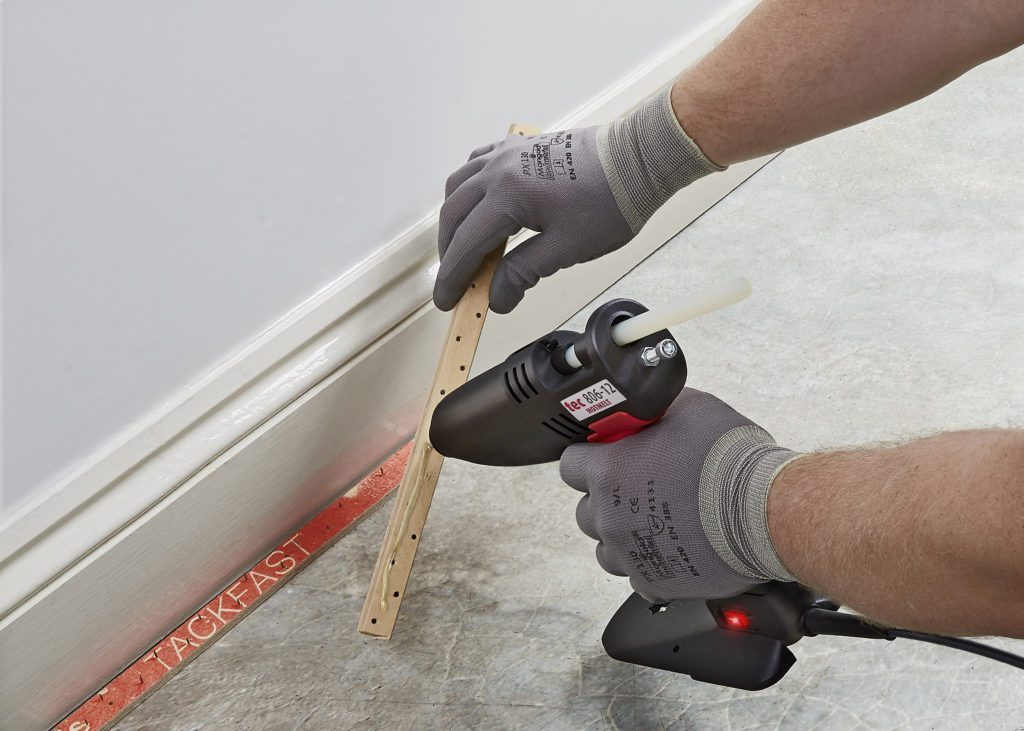
Spraytec 420 is a more general-purpose adhesive, primarily used in the manufacture of mattresses and HVAC units. It can also be used as a carpet adhesive, replacing the need for nails and tacks around stair nosing and skirting boards. It retains many of the same adhesive properties of spraytec 410, whilst offering the user more flexibility in both working conditions and bonding capabilities.

Complementing its three-minute open time, spraytec 420 has higher instant tack than spraytec 410, allowing substrates to be accurately positioned without the adhesive setting while ensuring a secure bond once substrate compression occurs.

For more information about spraytec adhesives, or to request a demo, please don’t hesitate to contact our sales team.

sales@poweradhesives.com

+44 (0)1268 885801

Three advantages of using hot melt adhesives for woodworking

The tecbond range of adhesives features many grades suitable for woodworking applications, with some specializing in bonding specific types of wood. Compared to traditional water-based or polyurethane wood glues, tecbond hot melt adhesives offer users a simple and effective solution to common bonding problems raised by woodworking applications.

Setting times

Most forms of wood glue, whether water-based or polyurethane-based, recommend clamping newly bonded materials and leaving them to dry for 30 to 60 minutes before moving or continuing additional work. Not only does this increase overall working time, but depending on the size of the job, it also requires several clamps to hold the wood together and a dedicated area to leave the wood while the glue dries.

Hot melt adhesives are 100% solid content, meaning there is no drying or evaporating. They instead have a setting period where they cool and form a bond between the two substrates, whether this is through physical or chemical bonding. This means there is no need for extended clamping times to achieve a strong yet flexible bond.

Tecbond 23, one of the strongest woodworking and product assembly grades available, only requires a clamping time of around five minutes before the bond is strong enough to be moved without causing adhesive or cohesive failure. Many other tecbond woodworking adhesives, such as tecbond 5 and tecbond 213, only need to be held in place for several seconds before they adequately set, allowing the structure to be moved.

After only 24 hours, bonds made using tecbond adhesives will have reached their maximum strength. Other comparable woodworking adhesives recommend being left to dry for up to 48 hours to achieve maximum strength.

No expiry, no blocked nozzles

Tecbond adhesives eliminate the annoyance of blocked nozzles or a half-dried product that’s near impossible to apply. Unlike most wood adhesives, the tecbond range of woodworking hot melts are solid sticks that aren’t affected by environmental conditions. They have a near-unlimited shelf life, with no risk of drying out or warping to the point of being unusable.

Most water-based wood adhesives have a maximum shelf life of around one to two years before bacteria begin to grow in them. This usually results in the adhesive turning solid and, in some instances, starting to smell.

These adhesives are also prone to freezing due to their water content, making them unusable in colder climates or winter conditions. Rather than changing their storage requirements to prevent this from happening, most users will tend to purchase a new adhesive if their current one shows signs of change or expiration.

Works when bonding wood to other materials

Many of the most popular wood glues are designed to only bond wood and struggle to bond any other substrate. Their high water content translates to lower viscosity, ensuring they flow into the porous surface of the wood. This generates lots of small physical bonds, something that isn’t possible with less porous materials such as metal and hard plastics.

Conversely, the range of tecbond hot melts, although formulated to work on specific substrates, will effectively bond a wide variety of materials. Grades like tecbond 23 and 213, although primarily woodworking grades, will also work on cardboard, ceramics, and fabric.

For more information on our range of woodworking grades, or if you would like to request a sample, please don’t hesitate to contact our sales team.

sales@poweradhesives.com

+44 (0)1268 885801

Reduce costs with the vactac hot melt system

The vactac hot melt system is the cleaner, safer, and more cost-effective alternative to aerosol-based adhesives, used for attaching composites in the vacuum infusion process. Not only does vactac provide more secure bonds in a fraction of the time, but it also does so without generating waste.

How it works

Unlike traditional spray adhesives, vactac adhesives are applied using Power Adhesives’ specially designed applicators. The tec 6300 and 7300 dispense adhesive in a “swirl” pattern using compressed air and a unique nozzle that turns the extruded bead into a thin, spiral filament. The spiral pattern is easily adjustable to create a thinner filament over a wider area.

As the adhesive is applied, it rapidly cools and creates a wider area of coverage than can be achieved by other hot melt applicators. Unlike spray-can adhesives, there is no atomisation of particles, a particular problem when these adhesives contain harmful solvents or VOCs.

Cost saving benefits

Any solvent-based adhesive will have a number on the can or canister showing how much of the contents are solid, usable adhesive. This can be anywhere from 10% to 40% or 50%, depending on the adhesive, with a higher number, signifying more adhesive in the can. Used aerosol cans must also be disposed of, which can incur further costs.

Containing zero VOCs or solvents, the vactac system allows customers to use 100% of the adhesive, with no waste product. Any remaining adhesive left in the applicator is simply remelted the next time it’s switched on without impacting its adhesive qualities.

As well as being easy-to-use, vactac adhesives provide a higher instant tack than most other spray equivalents, which also encourages the use of less adhesive. Ensuring an almost instant hold upon composite placement, this also helps to prevent overspray, a common issue when working with adhesives that atomise when sprayed. Overspray can cause an unnecessary mess to working environments and create potential bonding issues, with extra adhesive causing an uneven surface, meaning some areas may not make sufficient contact with the substrate.

As mentioned previously, the unique application method for vactac cools the adhesive far more quickly than is achievable via other applicators. This means vactac adhesives work with heat-sensitive substrates such as foam or expanded polystyrene without causing damage.

To see how much you could save, or for more information on the vactac system, please don’t hesitate to contact our sales team.

sales@poweradhesives.com

tel: +44 (0)1268 885801

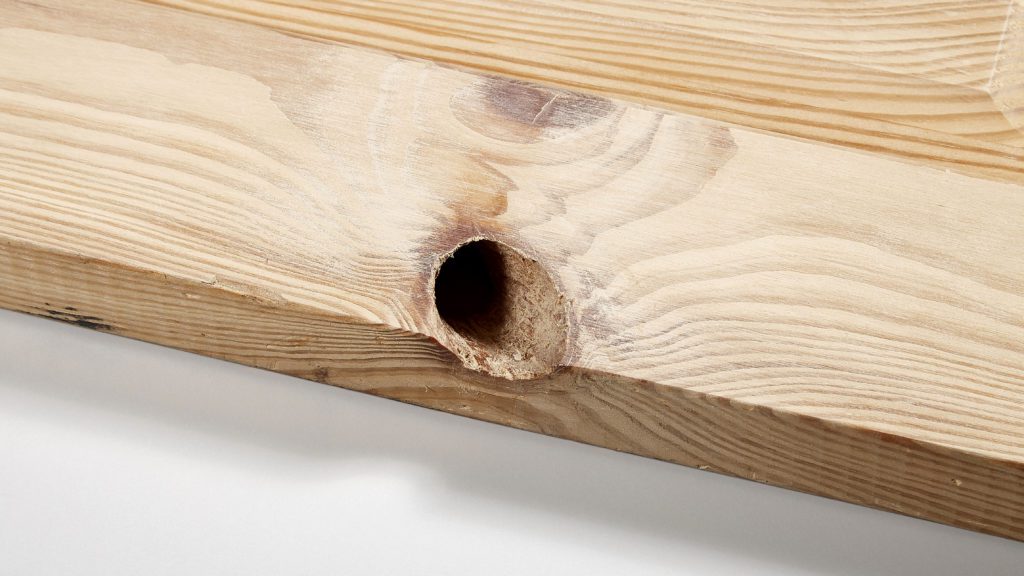
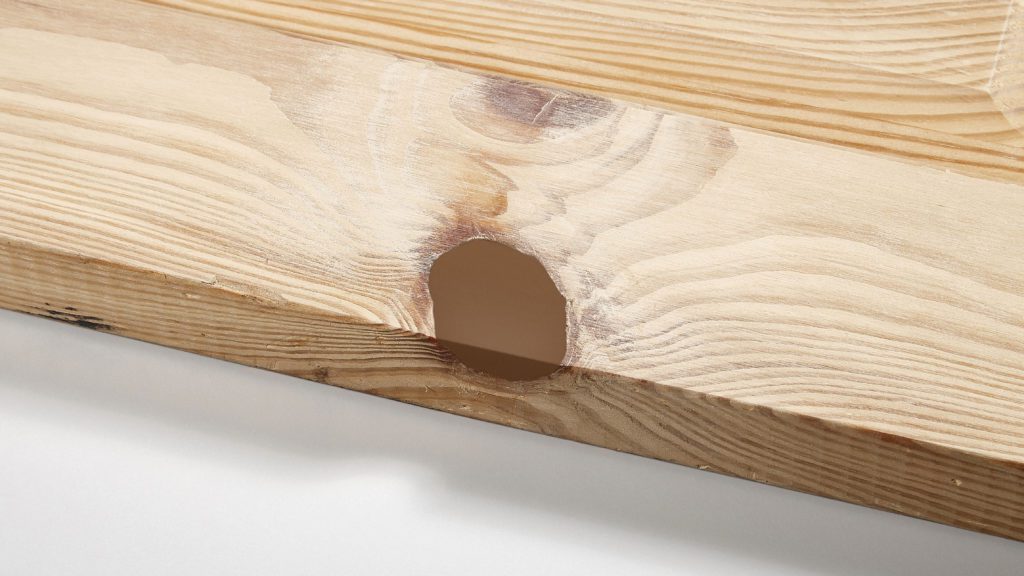
Knottec 7713 – The more efficient way to fill and repair wood defects

Filling and repairing knots, scratches, splits, and large voids in wood can be a costly and time-consuming operation, with not all repair systems guaranteeing consistent, long-lasting results.

Knottec 7713 has been specifically formulated for the fast and long-lasting repair of these wood defects, while adding many adhesive benefits that other systems cannot offer.

The polyamide-based hot melt filler provides tough, hard-wearing repairs on indoor hardwood objects such as wooden doors, hardwood flooring, and furniture. Requiring very little preparation and working time, knottec 7713 is most commonly used in the hardwood flooring industry as an alternative to wood putties and epoxies.

Available in 17 different shades to achieve the best colour match possible, knottec 7713 doesn’t require any mixing or moulding like putties and epoxies. As well as cutting down on potential waste, this also allows the user to start work straight away.

Knottec 7713 can be dispensed from the glue gun almost immediately, with one 12mm stick able to fill several large knots and voids with no downtime in between. Once applied, rather than having any waste filler left over, the glue stick can be left in the gun and remelted the next time it’s switched on.

After application, knottec adhesives will dry within minutes rather than hours, a process that can be accelerated further with the use of the knottec heat sink blocks or heat sink tool. These help to not only compress the material into the defect and ensure the area is properly filled, but also cool it as quickly as possible. The finished area can then be trimmed, sanded, and painted in the normal way.

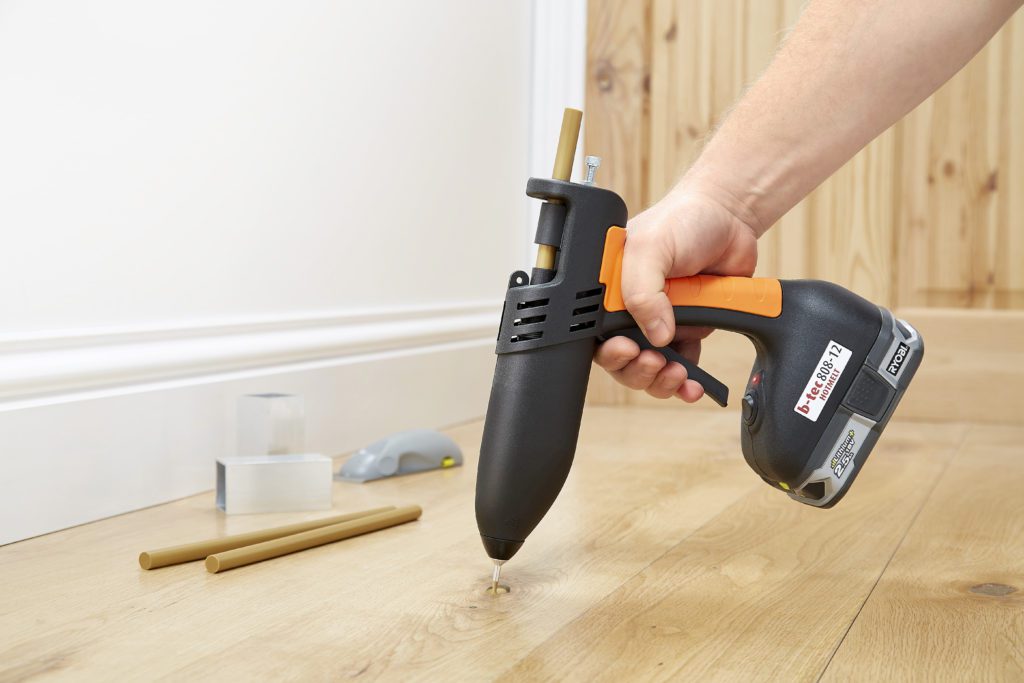
Alongside its filling capabilities, knottec 7713 has many adhesive properties, allowing it to be used for certain bonding applications, the most common of which is securing loose hardwood flooring panels where ‘voids’ have formed. The user simply drills a hole in the affected floorboard and dispenses a small amount of knottec 7713 into it before pressing down to form a bond. Any overflow material can then be trimmed and sanded down.

As with all the adhesives in the tecbond range, knottec 7713 is non-toxic, containing no organic solvents or harmful chemicals. With its sealed zip-lock packaging and silica pouches, knottec 7713 is protected from oxygen and moisture, giving it a guaranteed shelf life of two years when kept in this condition.

For additional information about knottec, including sample requests, please don’t hesitate to contact our sales team.

sales@poweradhesives.com

+44 (0)1268 885801

Five applications for hot melt sprayable adhesives

Power Adhesives unique spraytec system has revolutionised the application of hot melt adhesive to substrates that would otherwise be difficult to work with. Designed to apply adhesive in a spiral or swirl pattern, the spraytec glue guns provide wider coverage compared to bead application. This not only speeds up the application process but also improves overall bond strength thanks to the tension being spread over a wider area.

Together with the range of spraytec adhesives, these guns can be used for a variety of different applications, providing a number of benefits for each.

Attaching foam to the inside of packing crates

Many heavy-duty packing crates, including flight and musical instrument cases, use open-cell foams on the inside walls to protect fragile components. These foams are usually held in place by aerosol spray adhesives to avoid damaging the foam. The main issues with these adhesives are the VOCs (volatile organic compounds) given off during application, and their softening points in warmer climates leading to failing bonds.

Spraytec adhesives are designed to be applied to heat-sensitive substrates without causing damage. This is achieved via the unique spraying method, which cools the adhesive as it’s dispensed. Furthermore, spraytec adhesives are free from organic solvents or harmful chemicals, meaning they are safe to handle and use without the need for respiratory PPE. All spraytec grades also feature excellent high- and low-temperature resistance, decreasing the likelihood of “creeps” in the bond when exposed to different environments.

Carpet Installation

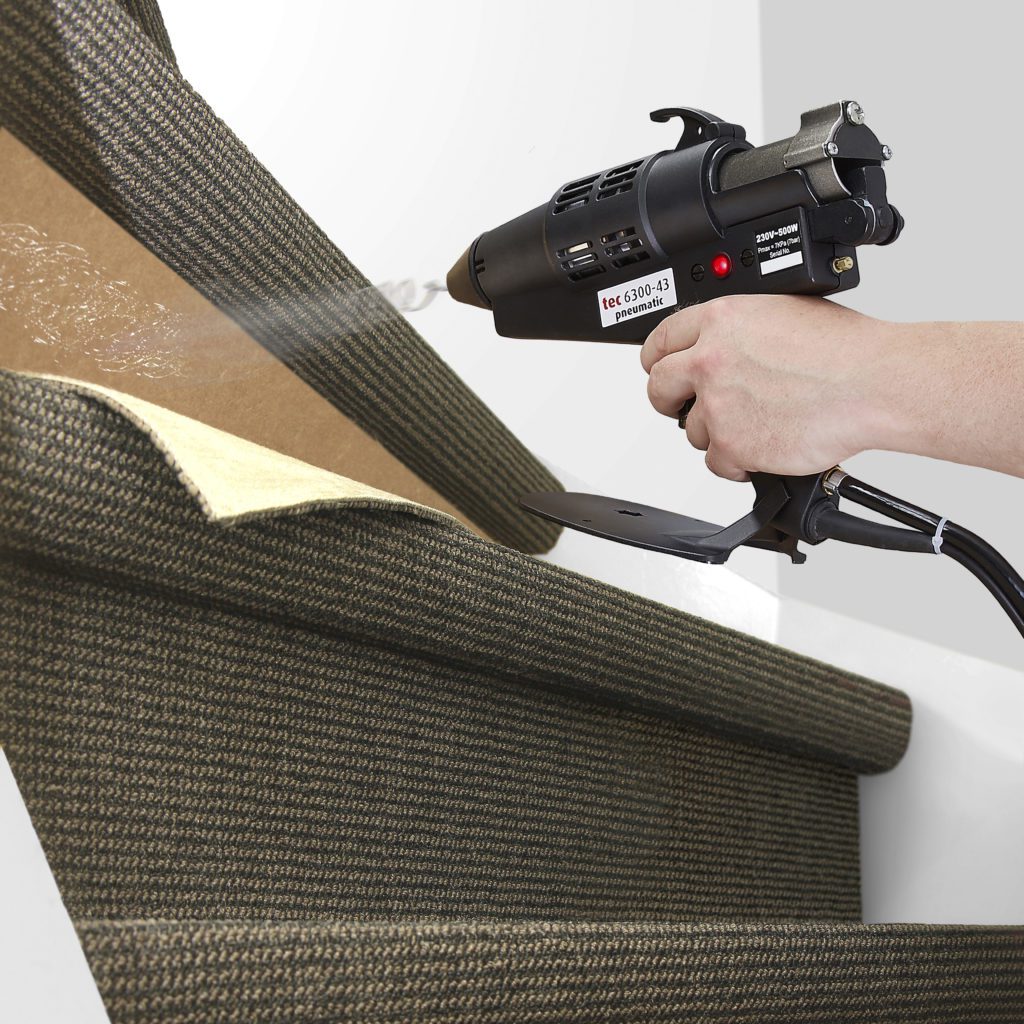
The spraytec system can speed up the installation of carpets and floor tiles in all areas of the home and workplace. Most carpet installers will use a contact adhesive (usually solvent-based) to bond carpet or underlay to wooden floorboards or concrete floors. For large sections of flooring, several cans of contact adhesive are required to ensure full coverage with no movement or peeling. These adhesives are also prone to fail at high temperatures.

Craftsman carpeting a staircase with vintage tools

Conversely, spraytec applicators ensure an even, wide adhesive coverage with no overspray thanks to the unique spraying method. This, coupled with the adhesive’s high tack and temperature resistance, allows for a fast, yet reliable bond with no waste product. Any adhesive left in the applicator after use can simply be remelted the next time the tool is switched on.

Pallet stabilisation

One of the main uses for spraytec 410 specifically, is pallet stabilisation. Best used with stackable items such as boxes and bags, the adhesive is sprayed onto each stackable layer to form a non-slip bond between materials.

A great replacement for shrink wrap and pallet walls, the adhesive has the necessary bonding power to allow shipments to be moved about and tipped without products sliding or falling off the pallet. When unloading the pallet, the adhesive is easily removable without damaging the substrates it was sprayed onto.

Mattress Manufacturing

An important part of mattress manufacturing is bonding the soft top to the spring bed. The adhesives used in this process require a very high tack to hold the topper accurately and firmly upon compression. Although solvent- and water-based adhesives provide the instant grab required, both have several drawbacks. Solvent-based adhesives, as mentioned previously, produce VOCs and unpleasant smells when applied, while water-based adhesives encourage mould if not allowed to dry properly.

The spraytec system provides an instant grab upon compression thanks to the adhesives’ very high tack and wide coverage. Additionally, hot melts do not produce any unpleasant smells or water vapour, removing the issues caused by other forms of adhesive.

Additionally, spraytec adhesives have a much longer open time than other types of adhesive, meaning the soft top can be manoeuvred and accurately positioned before substrate compression, without the adhesive drying and losing its tack.

HVAC – Heating, ventilation, and air conditioning

All heating and air conditioning units require thermal insulation to perform properly. The adhesives used to bond this insulation must be temperature resistant, moisture resistant and minimise flame spread and smoke development in accordance with UL 2395 standards.

Spraytec 420 and 425 are both UL 2395 certified and offer the same bonding properties and temperature resistance as water- and solvent-based adhesives, with none of the drawbacks previously mentioned. 420 and 425 also benefit from a three-minute open time, allowing the insulation to be properly positioned before substrate contact is made.

For more information about the spraytec system, you can read our blog post on how the spraytec system is kinder to people and the planet.

Alternatively, if you’d like to speak to a salesperson about spraytec, including sample requests and bonding requirements, please don’t hesitate to send us an email or give us a call.

sales@poweradhesives.com

tel: +44 (0)1268 885801

Tecbond 267W – The solution to bonding polyolefin plastics

Polyolefin plastics such as polypropylene and polyethylene have always proven difficult to bond. Many adhesives are unable to effectively wet the surface of these plastics to form a chemical bond, or to penetrate the polymer chains to form a physical bond.

Tecbond 267W is a white, polymer-based hot melt adhesive designed to bond polyolefin plastics through a chemical bond. Best applied at around 200 °C for maximum adhesion, tecbond 267W can also be used to bond materials such as polycarbonate, nylon, rigid PVC, and light gauge metals.

Mainly used in the production of crash helmets, sun visors, automotive trim, and white goods (fridges, washing machines, etc.), tecbond 267W is the perfect adhesive for many product-assembly applications with its high bond strength and effectiveness on a range of substrates outside of just polyolefin plastics.

Beyond its ability to bond difficult substrates, tecbond 267W’s main property is its high- and low-temperature resistance. Finished bonds can be subjected to temperatures of around 100 °C at their highest point and 0 °C at their lowest point, without compromising their strength or rigidity. This allows the adhesive to be used in a variety of environments and in the production of goods that require fluctuating temperatures, such as fridges, washing machines, and tumble dryers.

To complement its temperature resistance, tecbond 267W bonds have enough flexibility to withstand small amounts of movement and impact. This is particularly important when used for applications such as automotive interior trim, which experience prolonged bond stress from small movements.

Available in 15mm diameter sticks, tecbond 267W works best with the range of tec 15mm bead application glue guns. The tec 15mm applicators benefit not only from higher output than 12mm applicators, but they also decrease user fatigue, with each trigger pull requiring less effort for similar amounts of adhesive as a 12mm applicator.

Tec applicators are designed to work in tandem with tecbond adhesives to provide users with optimal performance and the highest possible output. With heat-up times of less than three minutes and optional nozzles to suit a variety of applications, tec applicators are the ideal tools for hot melt adhesive application.

For additional information, including sample requests, please don’t hesitate to contact our sales team.

sales@poweradhesives.com

+44 (0)1268 885801

Tecbond 7784 – The polyamide adhesive for bonding difficult substrates

Power Adhesives’ range of polyamide hot melts offers users tough, long-lasting bonds on a variety of substrates that would otherwise prove difficult to join. The composition of these adhesives means they are far more chemically resistant than hot melts made from EVA or polyolefin.

Tecbond 7784 is an amber adhesive designed for use on metal, wood, glass, ceramics, and many plastics. 7784 has been specially formulated to provide both high and low-temperature resistance, with strong and flexible bonds at temperatures as high as 120°C and as low as -60°C. This makes it especially useful for many product-assembly and electrical applications involving working machinery.

As with many other polyamide adhesives, 7784 is resistant to most oils, fuels, and grease as well as mild chemicals. It is commonly used in car engines and oil filters to not only hold components in place but also prevent some components from coming into contact with each other (such as oil filter fins). Using 7784 in these circumstances cuts down on extra material costs and provides a less destructive method of bonding compared to bolting and welding.

Due to the difficult substrates it needs to bond and the environments it’s used in, tecbond 7784 features a very high molten tack. This ensures an almost instant grab upon compression, removing the need for clamping or holding in place.

To complement its high tack, tecbond 7784 benefits from a long open time, allowing users to accurately position materials before forming the bond. For users with automated processes, the extended open time removes the worry of potential adhesive failure from cold bonds or low compression times. Additionally, once set, the bond provides an oxygen barrier, lessening the likelihood of mold in oxygen- and moisture-rich environments.

Available in 12 and 15mm sticks, and 43mm slugs, tecbond 7784 works best with the range of tec applicators. Both adhesives and applicators are developed alongside each other to provide optimal results and the best possible performance for the user. 7784 is also available in bulk pellets.

Sealed in foil-coated, resealable bags, tecbond 7784 is protected from oxygen and moisture, giving it a guaranteed shelf life of two years – double that of comparable polyamide adhesives.

For additional information, including sample requests, please don’t hesitate to contact our sales team.

sales@poweradhesives.com

+44 (0)1268 885801